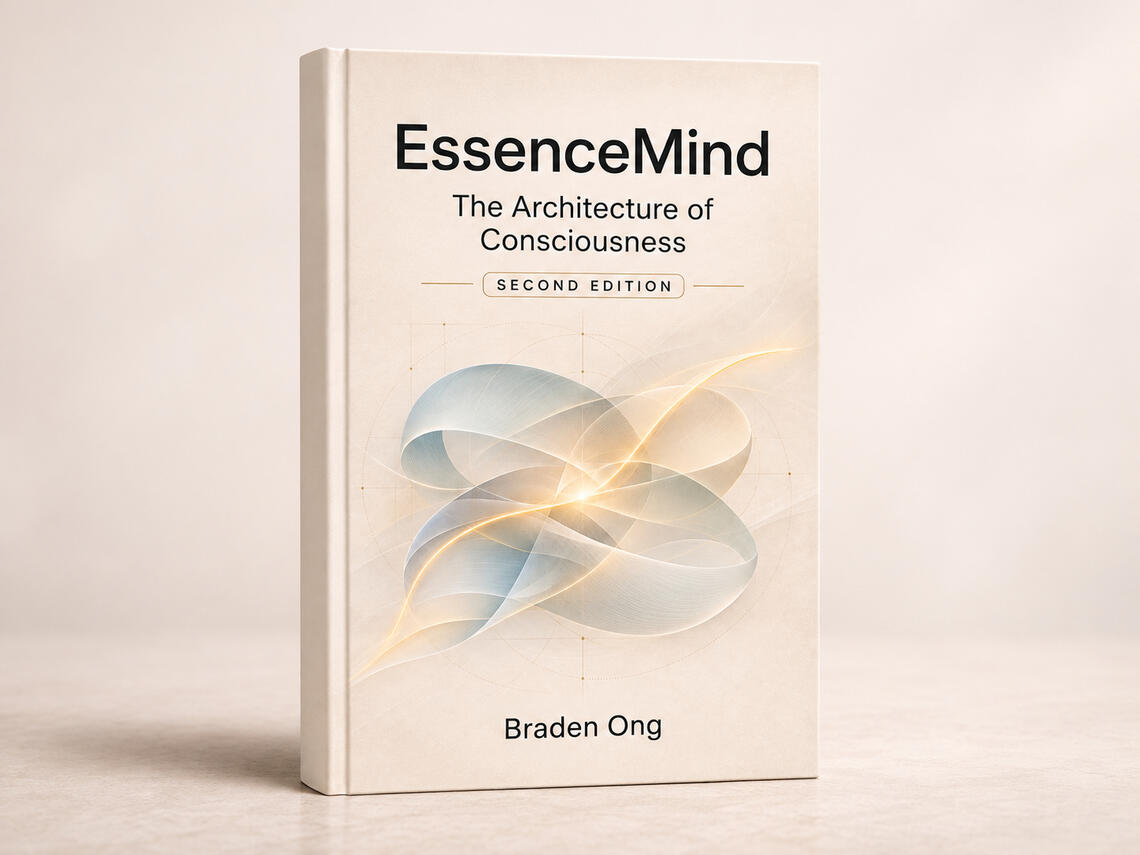
EssenceMind: The Architecture of Consciousness
Introduction
We often think of consciousness as something private, unfolding somewhere behind our eyes. Yet as I began studying brainwaves, meditation, intuition, relationships, and the influence of our surroundings, I became increasingly curious about how much our experience of ourselves changes with the circumstances of our lives.Consider what happens during a difficult conversation. Your attention may narrow to a few words. You might find yourself defending a position you hadn't realized mattered so much. Later, when the emotion has settled, you may see the same conversation quite differently. The circumstances haven't necessarily changed, yet something about the way you experienced them has.As I studied brainwave activity and listened to people describe their experiences, I began noticing similar changes across very different situations. I encountered them in meditation, in conversations about relationships, and in the ways people responded to personal challenges.Certain patterns kept appearing.Our awareness could become narrow or expansive. The way we experienced ourselves could change, sometimes without our realizing it. And the meaning we gave to an event could shift, even when the event itself remained unchanged.I also became interested in how these different aspects of experience worked together. Sometimes they seemed to support what a person was trying to accomplish. At other times, they pulled in different directions.Over time, I began to recognize a pattern of organization within these experiences. I came to understand it through four interrelated dimensions: Awareness, Identity, Perception, and Coherence.I call this framework EssenceMind.The word architecture might bring to mind something fixed, like the structure of a building. The architecture I'm describing is living and responsive. Its dimensions offer a consistent way to understand conscious experience, while their expressions change as we move through different circumstances. Coherence describes our capacity to coordinate these dimensions in support of intention, allowing us to respond in ways appropriate to what we are seeking to accomplish or express.Once we begin recognizing this architecture, familiar experiences can take on new meaning.Perhaps you've noticed how differently you respond to the same person depending on how you feel about yourself that day. Or how a moment of genuine connection can change your understanding of a relationship. Sometimes an intuition arrives before you can explain it, or an unexpected challenge reveals a side of yourself you rarely encounter.These moments offer glimpses into the ways consciousness organizes experience. They can also help us understand why certain reactions seem so familiar, why some situations bring out capacities we didn't know we had, and how our relationship with ourselves and others continues to evolve.Throughout this book, we'll explore these patterns in greater depth. We'll consider how Awareness, Identity, and Perception influence our experiences, how Coherence supports their coordination, and how the architecture adapts as our circumstances and intentions change. Along the way, we'll draw on observations from meditation, brainwave research, relationships, and ordinary life.My hope is that EssenceMind gives you something you can carry into your own experience: a language for recognizing what is happening within you, a map for understanding how the different aspects of consciousness work together, and a deeper appreciation of the intelligence already present in the way you meet life.You may recognize patterns you've lived with for years without having words for them. Some discoveries may bring clarity, while others may invite you to reconsider familiar assumptions about yourself. Each offers another opportunity to understand the architecture through which your experience unfolds.There is something meaningful about discovering that the ways we experience ourselves and the world have an underlying organization. As we become more familiar with that organization, we may begin to recognize possibilities that were difficult to see before.That is where our exploration of EssenceMind begins.
The following chapter introduces the perspective that guides the entire work.
It does not attempt to explain or apply the framework in full.Readers who resonate with this orientation will find the rest of the book unfolds it carefully and in depth.
Chapter 1 — Rethinking Consciousness: The Emergence of the EssenceMind
What do we really mean when we talk about consciousness?We know what it feels like to be awake, to pay attention, or to notice our own thoughts. These experiences are so familiar that we rarely question what lies beneath them. Yet the more closely we examine consciousness, the more difficult it becomes to explain how it works, why it changes, or why two people can experience the same situation so differently.There are many ways to approach these questions.A neuroscientist might examine what is happening in the brain. A psychologist may explore the influence of memory, emotion, and attention. Philosophers ask deeper questions about the nature of conscious experience itself, while contemplative traditions have spent centuries exploring what happens when our ordinary awareness changes.I've found something valuable in each of these perspectives.Yet one question kept drawing my attention, especially as I began observing how differently people experienced similar situations.
Why can two people encounter the same event and come away with such different understandings of what happened?Consider how two people might respond to the same difficult situation. One quickly identifies the practical problem and begins working toward a solution. The other senses the emotional tension beneath what is happening and recognizes that something important has been left unsaid. Both may understand the situation, although their attention has moved in different directions and their interpretation of what matters may differ.You may have noticed similar differences in your own life. Perhaps you understand something immediately when you see it represented visually, while another person needs to talk it through. You might discover your clearest insights during quiet reflection, while someone else finds clarity through movement, conversation, or creative expression.Even our sense of who we are can vary. Some people naturally experience themselves as observers, watching their thoughts and feelings unfold. Others experience themselves primarily through action, relationships, emotion, or the meanings they draw from events.These differences reflect the many ways human consciousness can organize experience. They are influenced by our temperament, history, learning, relationships, and surroundings. And although we may develop familiar ways of experiencing the world, those patterns can change.Think about how differently you might respond to a challenge when you feel secure compared with a moment when you feel threatened. Your attention may shift, your sense of yourself may change, and you may interpret the same information in an entirely different way. What once appeared overwhelming may later seem manageable, even though the facts remain largely unchanged.Something within the organization of your experience has shifted.Over time, observations like these led me toward a different way of thinking about consciousness. I began to wonder whether the many variations we experience might be understood through an underlying structure—a recognizable architecture whose expressions change with the circumstances of our lives.This became the foundation of EssenceMind.EssenceMind grew from these observations. Its four dimensions—Awareness, Identity, Perception, and Coherence—offer a way to understand how our experiences are organized.We've already encountered these dimensions in familiar situations. Attention shifts. Our sense of who we are changes. We begin interpreting something differently. And throughout these movements, the different aspects of our experience influence how effectively we can respond to what matters.The underlying architecture is shared, although each of us expresses it in ways shaped by our individual lives.The architecture is shared, yet its expressions are deeply individual.I sometimes think of this relationship through the image of an orchestra. Each instrument has its own character and possibilities, and the music changes as different instruments come forward. At one moment, a single instrument may carry the melody. At another, several instruments contribute to something more complex. Even a sharp, forceful passage may be entirely appropriate to the music being played.What matters is how the instruments respond to one another in service of the music.
Consciousness has a similar capacity for coordination. When a situation calls for immediate action, Awareness may narrow toward what is urgent. Identity may organize around the role of someone who needs to act, while Perception focuses on the information necessary for a decision. In another situation, where understanding or connection matters more, Awareness may widen, Identity may become more receptive, and Perception may reveal meanings that were previously overlooked.Both configurations may serve their respective intentions effectively.This is an important aspect of Coherence. Its expression depends partly on what we are trying to accomplish, and the same configuration may be helpful in one circumstance while limiting us in another. Coherence is therefore more than a feeling of harmony or clarity. It is an underlying capacity for coordination and adaptation, one whose expression can become more flexible as we learn and develop.You may recognize this in moments when something changes unexpectedly.Perhaps you have struggled with a decision for days, examining the same possibilities without finding a satisfying answer. Then, during an ordinary conversation, someone says something that causes you to see the situation from another perspective. The facts may be familiar, yet their meaning has changed. With that shift, a different response becomes available.Or consider a moment when you realize that your reaction to someone has more to do with an old experience than with what is happening now. You may still feel the same emotion, but your relationship with it begins to change. You can recognize the feeling while also seeing the person and the situation more fully.Such moments reveal something about the flexibility of consciousness. Our familiar ways of interpreting experience can change, sometimes gradually and sometimes with surprising speed.The same is true of Identity. We may become so accustomed to a particular role or self-understanding that it feels inseparable from who we are. Someone who has spent years being responsible for others may find it difficult to receive support. A person who has learned to remain guarded may struggle to recognize when openness is possible.These patterns often developed for understandable reasons. They may have helped us navigate difficult circumstances, establish a sense of security, or maintain relationships that mattered to us. As life changes, however, the same patterns may no longer serve every situation equally well.Recognizing the architecture gives us another way to understand these experiences.Instead of judging a familiar reaction simply as a flaw, we can become curious about how it came to be organized. What are we noticing? What sense of ourselves is active? How are we interpreting what is happening? And what intention, whether consciously recognized or quietly operating beneath our immediate attention, might be shaping our response?These questions can reveal possibilities that were previously difficult to see.They also help explain why approaches to personal development affect people differently. A practice that brings one person clarity may leave another feeling constrained. Someone who naturally processes experience through imagery may benefit from allowing that capacity to participate, while another person may discover insight through careful analysis or emotional reflection.Understanding our individual patterns can help us recognize which approaches are useful in a given circumstance and where greater flexibility might be possible.
This is one reason EssenceMind begins with understanding rather than improvement.We often approach personal growth with an image of the person we believe we should become. We may imagine ourselves calmer, more focused, more intuitive, or less affected by difficult emotions.These aspirations can be meaningful, especially when they reflect something we genuinely value. Yet they can also lead us to overlook the capacities already present in the ways we experience life.Learning to recognize our architecture creates a different starting point. We begin to understand how our responses are organized, what influences them, and how they might change as our circumstances and intentions evolve.Sometimes this recognition brings a sense of ease. At other times, it reveals patterns we would rather avoid. We may discover that a familiar interpretation has limited our understanding, or that an identity we have relied upon no longer reflects the person we are becoming.Such discoveries can be uncomfortable. They can also become part of a more honest relationship with ourselves.
Over time, our capacity to coordinate Awareness, Identity, and Perception may become more flexible. We may find ourselves recovering more readily after disruption, considering perspectives that once felt inaccessible, or responding differently to situations that previously drew us into familiar reactions.Development rarely follows a perfectly predictable course. There may be periods of clarity followed by confusion, moments of openness followed by the return of old habits. The circumstances of our lives continue to influence what is available to us, and even well-established capacities can become difficult to express under sufficient pressure.EssenceMind remains present throughout these changes. Its dimensions continue to participate in experience, even when their coordination is strained or our available responses feel limited.There is an important boundary to recognize here, particularly when we consider suffering.Understanding the architecture of consciousness does not explain away the realities of harm, loss, or injustice. Some experiences are devastating, and their consequences may remain with a person for a lifetime. The ability to describe how consciousness responds to such events does nothing to diminish their seriousness or make them acceptable.This distinction becomes especially important when considering violence, abuse, and the influence of harmful social systems. EssenceMind may help us examine how Awareness, Identity, and Perception operate under different conditions, including those shaped by fear, power, or collective influence. Yet understanding these processes does not transfer responsibility to those who have been harmed. Responsibility for harmful actions remains with those who commit or enable them.Coherence, as a capacity for coordinating consciousness in support of intention, should also be distinguished from moral goodness. A person or group may organize its actions effectively around an intention that causes harm. The ethical significance of that intention, and the consequences of acting upon it, must be considered in their own right.For someone living with grief, trauma, or profound loss, there may be times when explanation offers little comfort. Anger, sorrow, and a refusal to make meaning from what happened may be entirely understandable responses. EssenceMind is offered as a way of understanding the organization of experience, while respecting the realities that cannot be resolved through a framework alone.Our surroundings also matter. The relationships we live within, the demands placed upon us, and the environments in which we spend our time all influence how our capacities can be expressed. A person may find it easier to respond with flexibility in a supportive environment and considerably harder when faced with ongoing threat or instability.
This is why the architecture cannot be understood entirely apart from the conditions in which a person lives.As we explore EssenceMind, we'll consider both the familiar range through which each person tends to experience life and the expanded possibilities that may become available through learning, experience, and changing circumstances. We'll examine how Awareness, Identity, and Perception express themselves in different situations, and how Coherence supports their coordination in relation to intention.Throughout this exploration, you'll encounter examples drawn from everyday life, relationships, meditation, and the study of brainwave activity. Each offers a different perspective on the architecture, helping us recognize patterns that might otherwise remain unnoticed.Perhaps you'll begin noticing familiar experiences a little differently.You might recognize why a particular conversation leaves you feeling defensive, or why certain situations bring out qualities in you that seem absent at other times. You may discover that a response you've always taken for granted has more to reveal about how you experience yourself and the world.Some of these discoveries may be reassuring. Others may challenge something you've believed about yourself for years.Either way, they offer an opportunity to become more familiar with the architecture through which you experience life.
And perhaps that's a meaningful place to begin—with the curiosity to understand ourselves a little more fully.
The EssenceMind: The Architecture of Consciousness book is
available for purchase here.